
SEO & GEO Optimization
SEO gets pages crawled and understood; GEO gets your site's facts used in AI answers. We explain the approach by object, interaction, and acceptance, covering both domestic and export platforms, with verifiable records of the process.
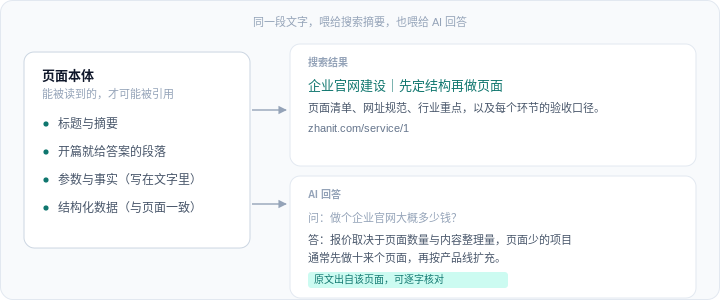
SEO gets pages crawled, understood, and correctly displayed by search engines; GEO gets the facts on your site used in AI answers. These aren't two separate jobs but two views of one foundation: clear entities, extractable facts, consistent wording, and a crawlable site. Get these four right and both sides benefit.
Why do them together now? More purchasing decisions start with an AI question—first "how do I choose this kind of equipment," then "who can do it." If your pages contain only design mockups and a slogan, AI has no sentence to cite and won't mention you. And what AI cites is often exactly the kind of "answer-first" paragraph that search-result snippets favor.
Both share one foundation
- Clear entities Your company name, service names, location, and what you do appear with identical wording across every page. Call the same thing three ways and a machine treats it as three things.
- Extractable facts Every service and product has a self-contained description that makes sense without surrounding context.
- Structured markup Use the appropriate schema for organization, services, FAQ, and articles—with fields matching the content visible on the page.
- A crawlable site robots.txt doesn't block by mistake, the sitemap is accessible, and key pages need no login. If this fails, the first three are wasted effort.
GEO: getting AI to use the facts on your site
GEO comes down to three actions: write "what it is, what it costs, how long it takes, whether you can do it" as extractable answer blocks; unify scattered statements into one fact ledger; and measure against a fixed question set regularly to see whether you're cited and cited accurately.
| Stage | Object | Interaction & approach | Acceptance |
|---|---|---|---|
| Baseline diagnosis | Real questions: brand, category, and scenario terms | Sample questions on domestic and overseas platforms; log brand and non-brand terms separately. | A question set, platform list, and raw answers are delivered. |
| Fact foundation | Company facts, service boundaries, credentials, case studies | Standardize the brand-definition sentence word for word; align languages for export. | A fact ledger and standard FAQ are delivered, with consistent wording across sources. |
| Structured improvements | JSON-LD, llms.txt, answer blocks | Use the question as the heading; give the answer in the first sentence, conclusion first. | Validation passes; each service has an independently extractable description. |
| Source layout | Corporate site, trade media, encyclopedias, communities, review platforms | Choose credible channels separately for home and overseas markets, aligned with the fact ledger. | A list of citing domains is delivered; low-quality sources are kept in check. |
| Export GEO | Multilingual export sites and overseas buyer questions | Ask questions in the target market's language; check whether citations point to your own site; configure hreflang. | Per-language questions and citation records are delivered; cross-links complete. |
| Adoption verification | Fingerprints and three question groups A / B / C | Compare before and after release; check the answer body, not just the citation list. | A fingerprint appearing in the body counts as adoption; the three groups aren't pooled. |
| Ongoing monitoring | Mention rate, recommendation rate, accuracy, source health | Re-run the fixed question set monthly; report ranges and trends only. | A monthly comparison table with raw records is delivered; gaps become next-round actions. |
Measurement is only comparable when the same wording is measured repeatedly.
SEO: making pages searchable and understandable
SEO may look basic, but the order matters: first make sure pages can be crawled and indexed, then fix titles and structure, and only then keep recording. Rewriting titles while crawl and index problems remain changes nothing.
| Stage | Object | Interaction & approach | Acceptance |
|---|---|---|---|
| Crawl & index | Sitemap, robots, canonical, internal links | Organize pages by hierarchy, submit the sitemap, clear dead and duplicate pages. | Target pages are crawlable and indexable, with no rule conflicts. |
| Titles & descriptions | Each page's title, description, and heading hierarchy | Rewrite to search intent, conclusion first, no keyword stuffing. | Search-result titles and descriptions match the page content. |
| Content structure | Service scope, industries served, specs, and FAQ | Organize by topic–dimension–Q&A; prefer tables and lists. | Target questions have a page answering them; key facts are verifiable. |
| Multilingual & export | Separate URLs, hreflang, multilingual sitemaps | Localize units and certification names to each market; no sentence-by-sentence translation. | Each language is independently crawlable; cross-links complete. |
| Structured data | Organization, Service, FAQPage, breadcrumbs | Keep fields in sync with content; use one wording per entity. | Tests pass; markup matches content visible on the page. |
| Periodic records | Indexing, impressions, clicks, broken links | Record monthly; keep home and export markets separate. | Reports include raw records for comparison with the baseline. |
Reports give ranges and trends only—no single data point is treated as a conclusion.
What you'll see, and what we can't promise
The sequence is: indexed first, then impressions, then clicks, and only then cited by AI. If any step is incomplete, nothing after it happens.
So claims like "results in three months" have no basis—they skip the first three steps.
- What we can promise Which pages are submitted, which titles and structures were changed, whether structured data validates, and what data is recorded monthly. All of it verifiable.
- What we can't promise Rankings, impressions, click volume, or how often AI cites you. These depend on platform rules and are outside a provider's control.
- What we shouldn't do Mass-produce near-identical keyword pages, buy links, or write unverifiable claims like "industry leading." These may look effective short-term but erode site-wide credibility over time, and AI citations will steer clear.
How to keep records that actually mean something
A number is less useful than a record you can re-run. Concretely: fix ten to twenty questions (covering "how to choose," "how much," "how long," "can you do it," "who can do it"), ask each on several platforms monthly, and record whether you were mentioned, how you were described, and which page was cited. After six months you'll see a trend and which page is doing the work.
If the same page is cited month after month, the other pages lack extractable content. If the description cited doesn't match the facts, there's a wording conflict somewhere. Both are visible in the records, and both point to a clear place to act.
When to do it—and when not to
If the site isn't indexed normally and key pages can't be crawled, fix that first; don't rush into content optimization. If your products only circulate among two or three long-standing clients and you don't rely on search for customers, the return on this investment will be limited—we'll tell you so directly.
Planning structure and extractability together during the build is the most economical route. For a site that's been live for years with a settled structure, targeted changes in the order of the two tables above are more appropriate.
Tell us about your project
No complete brief is needed. Tell us your target audience, the inquiries you expect, and your current challenges, and we'll give you a structural assessment.
Want to start with FAQ, or learn aboutProject Workflow。