
Export Websites & Multilingual Sites
Separate pages and URLs per target market, with hreflang and sitemaps configured. Product specs, certifications, and lead times are written as verifiable text that overseas buyers and AI can read.
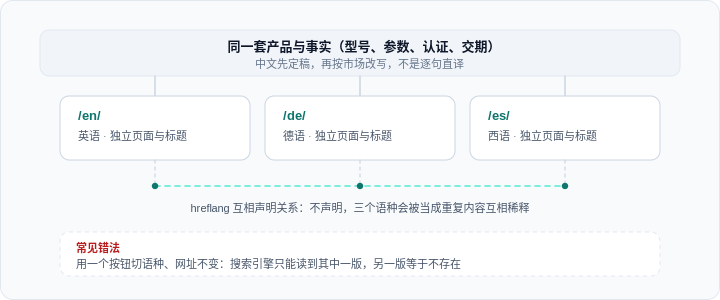
An export website is a site on your own domain, independent of any B2B platform. A buyer arriving from search or an AI answer sees your products, your specifications, and your lead times—with no platform price-comparison or competitor recommendations in between.
Its value isn't "one more channel"—it's that you build an asset you own: the pages, the content, and the record of being cited all stay on your domain. Traffic to a platform storefront belongs to the platform, and a rule change means starting over. Every piece of content and every backlink on your own site is still bringing people in three years from now.
This is not just translating your Chinese site
This is the most common—and most expensive—misconception about export sites. Translation solves a language problem; an export site solves a visibility problem. Their technical foundations are completely different:
- Each language gets its own URL English under
/en/, Spanish under/es/—each a standalone page. A button that swaps content while the URL stays the same means search engines only read one version; the other effectively doesn't exist. - Declare the relationship between them On every page, use hreflang in the head to point to the other language versions of that same page. Skip this and the language versions are treated as duplicate content, diluting each other.
- Write the facts as text Overseas buyers search in long phrases, e.g. "stainless steel 316 centrifugal pump for marine aquaculture." If that sentence isn't on the page, you won't be found; and when AI wants to cite you, there's no citable sentence to quote.
- Localization isn't literal translation Units, certification names, address formats, and payment terms all need rewriting for the market. Translate "payment before shipment" word for word and the buyer won't recognize it as a trade term.
How to roll out languages: do two or three markets thoroughly
Launching eight languages at once is the most common waste. Every language means separate content, separate product descriptions, and separate ongoing maintenance—and when translation quality drops, it hurts you. A sensible sequence:
- Pick two or three primary markets based on where your current inquiries come from, and do them thoroughly—full products, full specs, full certifications.
- After launch, watch three months of data. Add the next language only for a market with real inquiries.
- Once a language is live, it must stay in sync with the main site. Add a product to the main site without updating the others, and within months the gap is too wide to close.
The cost of adding a language isn't the translation—it's keeping it in sync from then on.
So decide the language scope during the structure phase, and don't add them one at a time afterward.
Facts your product pages must state
An overseas buyer judging an unfamiliar supplier relies on what can be verified, not adjectives. Product pages should include at least the following—all as text, not images:
- Model and specifications: a comparable spec table, with units written for the target market.
- Materials and workmanship: what the key components are made of, and what proof you can provide.
- Certifications: CE, RoHS, ISO and the like, with certificate numbers and issuing bodies.
- Minimum order quantity, lead time, packaging, and common trade terms.
- Suitable operating conditions and limits: stating when a product is not appropriate actually makes you more credible.
Only you can supply most of this content. We organize it into a structure the pages can use—but if a spec number is wrong and a client orders to the wrong spec, no amount of wording can fix the loss.
Workflow and acceptance criteria
The table below sets out our approach by object, interaction, and acceptance. Acceptance lists only what is actually delivered and can be verified—no ranking, citation-position, or traffic promises.
| Stage | Object | Interaction & approach | Acceptance |
|---|---|---|---|
| Language planning | Target markets and inquiry sources | Pick two or three markets from existing inquiry sources and do them thoroughly; add more based on data. | A language list and rollout order are delivered. |
| URL structure | Separate URLs, hreflang, canonical links | Give each language its own page and URL; configure cross-links and canonical tags. | Each language page is independently crawlable; cross-links are complete. |
| Product content | Specs, certifications, lead times | Written as verifiable text, not placed in images. | Key facts can be searched and verified. |
| Localization | Units, certification names, terminology | Rewritten to local market conventions, not translated sentence by sentence. | Each language reads like local industry usage. |
| Export GEO | Overseas platform questions and citation sources | Ask questions in the target market's language; check whether citations point to your own site. | A record of questions and a citation list are delivered. |
Only after the site is live do titles, descriptions, and citable answer text have something to stand on.
Five common traps
- One button to switch languages URL unchanged, content swapped by script—the search engine can't crawl the second language.
- Translating only the homepage and About page It's the product pages that generate inquiries; leave them untranslated and you haven't done multilingual at all.
- Specs as images They look professional, but can't be searched, extracted, or cited by AI.
- Servers located at home For Europe or North America, the first screen loads two or three seconds slower, bounce rate rises noticeably, and it raises local compliance and registration issues.
- Only an email address for contact An overseas buyer who sees no phone number, no working hours, and no address will trust you less.
How this relates to the other three services
An export site is usually an extension of the corporate site: first a well-structured site, then languages added by market. If you already have a Chinese site, in most cases it doesn't need rebuilding—you need to add language structure, product facts, hreflang, and structured data. Together, those three are exactly the scope of SEO & GEO work.
Tell us about your project
No complete brief is needed. Tell us your target audience, the inquiries you expect, and your current challenges, and we'll give you a structural assessment.
Want to start with FAQ, or learn aboutProject Workflow。