
Corporate Website Development
We define the sections and URLs first, then design the pages. Products, credentials, case studies, and inquiry entry points are laid out in the order clients read, with heading hierarchy and structured data delivered alongside.
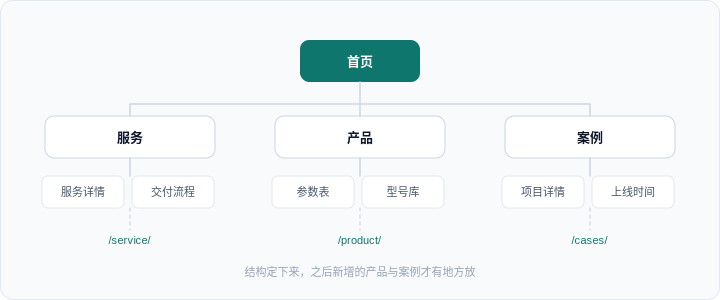
Your website is where a prospective client decides, before ever contacting you, whether your company is credible and capable of handling their project. It doesn't need to be flashy—but it does need to answer four questions within three minutes: what you do, what you've done, how you work, and how to reach you.
Our approach is to define the information architecture first—how sections are organized, how many layers the pages have, how URLs are structured—and only then design the pages. The logic is straightforward: structure determines where every future product and case study belongs. Get the structure wrong, and even the most beautiful pages will eventually have to be rebuilt.
What a good corporate website must do
- Easy to navigate A visitor arriving at the homepage can find the product or service they need within two or three clicks, without guessing what a menu item means. Navigation uses your customers' words, not your internal org chart.
- Easy to verify Model numbers, specifications, certifications, and lead times are written in text, not locked inside images. Search engines and AI can only read text; a spec that exists only in a picture might as well not exist.
- Easy to scale When you add a product line or a new section next year, it can be added in the CMS directly—no reformatting, no call to us for a code change.
None of these three points is about visual style, yet they determine whether the site is still usable three years from now.
Visuals can be adjusted at any time; changing the structure means touching the whole site.
Page inventory: one question per page
A twenty-page site and a sixty-page site use the same handful of page types. The difference is the number of products and case studies. A typical inventory looks like this, with each page answering a specific question:
- Homepage: what you do, who you do it for, and why you can be trusted. If the first screen can't answer these three, no amount of detail below will be read.
- Product/service listing: what categories exist and how they're grouped. Group them the way customers talk, not the way your workshop or departments are organized.
- Product detail: model, specifications, typical operating conditions, certifications, lead time, and minimum order. This is the real entry point for inquiries—if it's vague, the client will go ask a competitor.
- Case studies: what similar projects you've done, their scope, and what problems you solved. When you have no public case studies yet, use verifiable solution descriptions instead of fabricated screenshots.
- About: what the company does, how the team is structured, and how projects are run. This is where a client judges whether you're a team they can actually work with.
- Contact: phone, email, address, and a form. Keep the form to six fields or fewer—every extra field costs you submissions.
Different industries, different priorities
- Manufacturing and industrial products: with many models and specifications, the priority is a scalable structure for spec tables, so clients can filter and compare by spec. Specs buried in images are specs nobody can use.
- B2B services and professional firms: build trust through case studies and expertise. Pages should spell out service boundaries and delivery—what you do, what you don't, and how long it takes.
- Brand and consumer goods: balance visual impact with load speed; turn campaigns and content into pages that can be found through search, not one-off posters that go dark when the campaign ends.
Not in one of these three categories? That's fine. Most projects start with a single direction, and the first conversation maps out the page inventory and priorities together.
Workflow and acceptance criteria
The table below sets out our approach by object, interaction, and acceptance. Acceptance lists only what is actually delivered and can be verified—no ranking, citation-position, or traffic promises.
| Stage | Object | Interaction & approach | Acceptance |
|---|---|---|---|
| Information architecture | Products, certifications, case studies, inquiry entry points | Organize section hierarchy around the client's decision path; define URL conventions first. | A page inventory and URL structure are delivered. |
| Page implementation | Desktop and mobile viewports | Lay out each separately—no pinch-zoom in place of mobile adaptation. | Both viewports are readable, with no horizontal overflow. |
| Content structure | Product models, specifications, case studies | Use a structure that can keep expanding, not one locked into a fixed layout. | New products can be entered using the existing structure, without a redesign. |
| Search foundation | Each page's title, description, and heading hierarchy | Written to search intent, with the conclusion up front. | Search-result titles and descriptions match the page content. |
| Inquiry path | Consultation entry points and the contact page | Place reachable inquiry entry points on key pages. | Every main page has a clear entry point; the path can be completed. |
Three things we don't do
- No image-only showpieces They look good, but clients can't find them and AI can't read them—the site dies at launch.
- No ranking or traffic promises Those depend on platform rules. We can commit to the process—structure, content, submission, documentation—not the outcome.
- No empty pages to pad the count Generating near-identical pages just to look bigger erodes the whole site's credibility and dilutes indexing.
If, after assessment, we believe a DIY site builder suits you better—few pages, one language, content that rarely changes—we'll say so rather than push.
How this relates to the other three services
Corporate websites, export sites, SEO & GEO, and redesign & migration can each be done on their own or together. In practice, most projects run in this order: first a well-structured corporate site, then added languages as markets require, then ongoing tuning of content for search and AI readability. Get the structure right once, and the next two steps are additive; get it wrong, and every later step is debt repayment.
Tell us about your project
No complete brief is needed. Tell us your target audience, the inquiries you expect, and your current challenges, and we'll give you a structural assessment.
Want to start with FAQ, or learn aboutProject Workflow。